class
In Python, the class keyword lets you create user-defined classes, which are the cornerstone of object-oriented programming (OOP). With class, you can define the blueprint for objects, complete with attributes (data) and methods (functions).
Python class Keyword Examples
Here’s an example of how to define and use a class in Python:
>>> class Dog:
...     def __init__(self, name):
...         self.name = name
...     def speak(self):
...         return f"{self.name} says woof!"
...

>>> dog = Dog("Frieda")
>>> dog.speak()
'Frieda says woof!'
In this example, we define a Dog class with an initializer method .__init__() to set the dog’s name. The .speak() method is an example of a behavior that objects of the Dog class can perform. Then, you create an instance of the Dog class named dog and call its .speak() method to see the output.
Related Resources
Tutorial
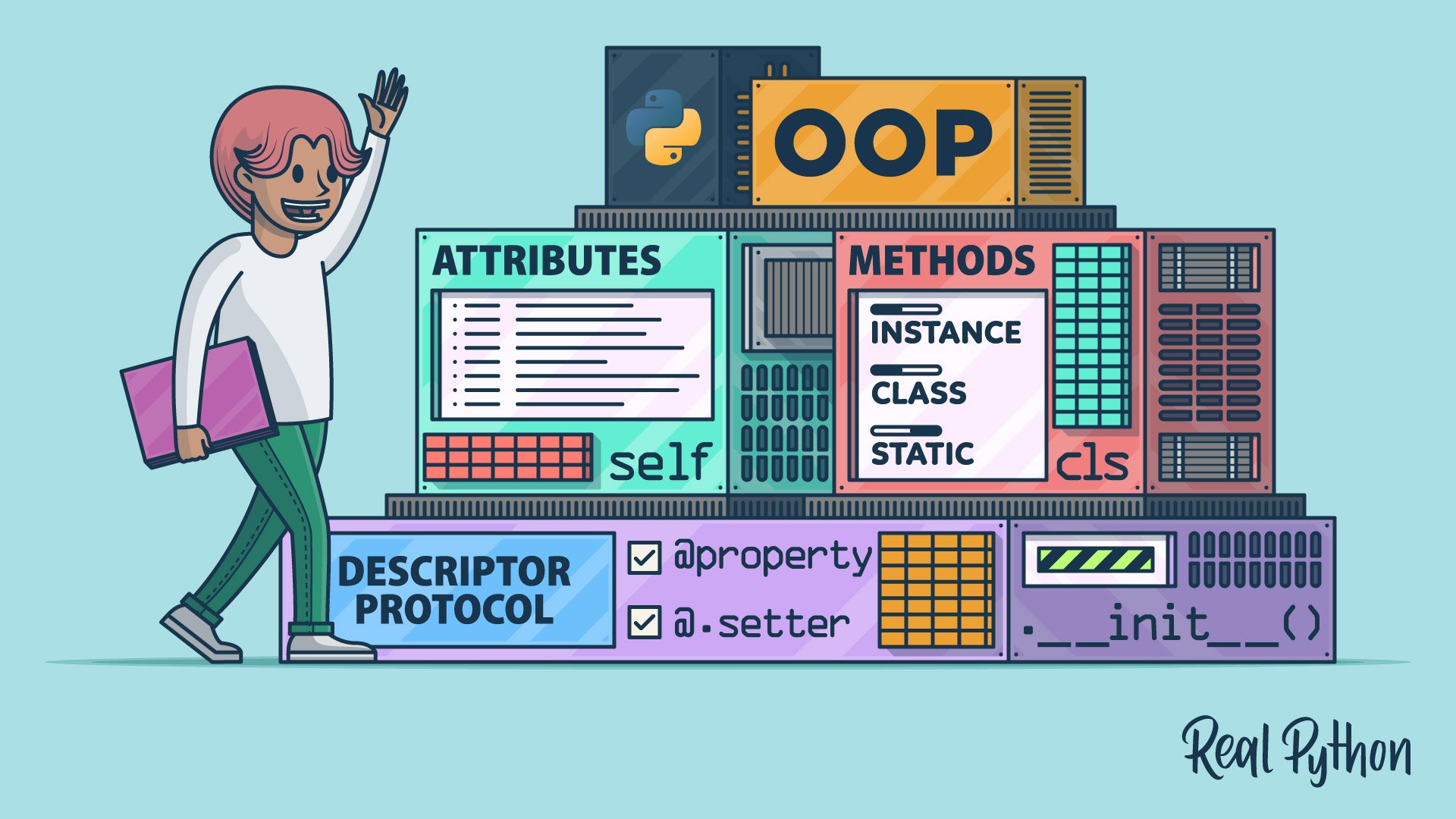
Python Classes: The Power of Object-Oriented Programming
Learn how to define and use Python classes to implement object-oriented programming. Dive into attributes, methods, inheritance, and more.
For additional information on related topics, take a look at the following resources:
- Object-Oriented Programming (OOP) in Python (Tutorial)
- Inheritance and Composition: A Python OOP Guide (Tutorial)
- Python Class Constructors: Control Your Object Instantiation (Tutorial)
- Inheritance and Internals: Object-Oriented Programming in Python (Course)
- Class Concepts: Object-Oriented Programming in Python (Course)
- Python Classes - The Power of Object-Oriented Programming (Quiz)
- A Conceptual Primer on OOP in Python (Course)
- Intro to Object-Oriented Programming (OOP) in Python (Course)
- Object-Oriented Programming (OOP) in Python (Quiz)
- Inheritance and Composition: A Python OOP Guide (Course)
- Inheritance and Composition: A Python OOP Guide (Quiz)
- Using Python Class Constructors (Course)
- Python Class Constructors: Control Your Object Instantiation (Quiz)